2015 Physics Haunted Lab
JOIN US FOR THE
PHYSICS HAUNTED LAB
From ghosts that appear when you wave a wand to a magic flying bat—there are plenty of reasons for every one of all ages to attend this free event!
JOIN US FOR THE
PHYSICS HAUNTED LAB
From ghosts that appear when you wave a wand to a magic flying bat—there are plenty of reasons for every one of all ages to attend this free event!
Dr. Daniel Stern
NASA's Nuclear Spectroscopic Telescope Array, or NuSTAR, launched in June 2012, and is the first telescope in orbit to focus high energy X-ray light. High energy X-ray light provides a unique probe of the most energetic phenomena in the universe, from flares on the surface of the Sun, to the explosions of stars, to the extreme environments around neutron stars and black holes. NuSTAR has discovered new classes of objects, such as neutron stars accreting at prodigious rates, and has provided uniquely robust measurements of how fast black holes are spinning. Compared to the previous generation of non-focusing observatories working in this energy band, NuSTAR's change in technology provides 10x sharper images and 100x greater sensitivity. This talk will present some of the highlights from the NuSTAR mission and describe how they are changing our picture of the extreme universe.
A live stream of the event will be available at http://livestream.com/CreightonUniversity/NuSTAR.
Abstract: The research presented in this thesis was carried out with the ALICE (A Large Ion Collider Experiment) detector at the CERN (European Organization for Nuclear Research) LHC (Large Hadron Collider). Two feasibility studies are conducted for Run 2 energies at the LHC. The first case studies the photo-production process of the ηc meson decaying to a four particle final state, π+π-K+K- in Pb-Pb ultra-peripheral collisions (UPCs).
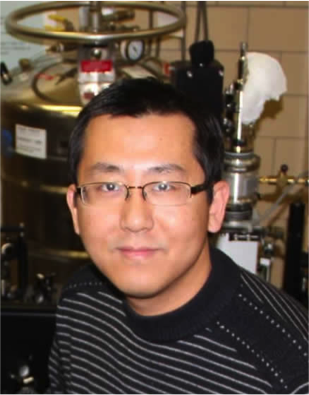
How Fast is Ultrafast: Non-Equilibrium Quantum Matter at 10-15 sAssociate Professor and Staff Scientist
Dept. of Physics, Iowa State University
Materials Science and Engineering Division: Ames Laboratory
The challenge to push the gigahertz (109 hertz) switching speed-limit of today’s logic and magnetic memory devices into the terahertz (1012 hertz) regime underlies the entire field of information processing, storage, communication as well as integrated multi-functional systems. I will discuss to implement an emerging theme: use ultrashort laser pulses to achieve ultrafast control of quantum materials and explore non-equilibrium quantum dynamics at femtosecond (fs, 10-15 s) timescales. This cross-cutting theme has merged different disciplines of current focus including condensed matter physics, quantum materials, ultrafast nonlinear optics, nano-photonics/-electronics... These provide increasing evidence, both from intellectual and practical point of view, on a paradigm shift for modern science and technology to engage ultrafast physics and technology. I will show some snapshots from recent published work from my group [1-5] to meet this ultrafast challenge.
Dr. Steve Rolston
Professor & Co-Director
Joint Quantum Institute
Dept. of Physics, University of Maryland
Where is My Quantum Computer?
Twenty years ago mathematician Peter Shor proved that a computer based on the laws of quantum mechanics could in principle factor large numbers in polynomial time, a problem believed to be exponentially difficult for classical computation. Given the importance of this problem to modern cryptography, it understandably stimulated a great deal of excitement and effort. Dozens of candidate systems have been proposed and many worked on, but we are still many years away from a machine that threatens our financial transactions. In this talk I will highlight the challenges to build large, controllable systems that maintain their quantum character, and look at where we are, where we will be going, and what we have learned along the way.
42nd Annual Physics Field Day
Presented by Creighton University’s Society of Physics Students
Saturday, March 28, 2015 Condensed Matter
Registration starts at 7:30, events start at 8:00 a.m.
You are invited to the Creighton University Physics Department’s Physics Field Day 2015! On Saturday, March 28, you and your team of high school physics students will duke it out with other local high schools for the title of “Field Day Champion.” This year’s theme is “Condensed Matter,” where we will explore physical principles that we encounter on a daily basis—though perhaps we do not think about them explicitly.
If you have any questions, please email SPS President, Katherine Bauer (KatherineBauer@creighton.edu) and she will get back to you as soon possible. Additional details and updates on Physics Field Day can always be found online at:
http://physicsweb.creighton.edu/content/field-day-hall-fame
More details on the events are also available in the 2015 Physics Field Day Rule Book
Our annual department retreat will be February 19-20th at the Carol Joy Holling Retreat Center.
From Physicist to Patent Lawyer
Matt Poulsen, Ph.D.
Suiter – Swantz pc llo
Patent law represents an intriguing career choice for many in the science and engineering disciplines. The number of patent applications filed in the U.S. has steadily risen for the past two decades. With the increased focus on intellectual property by developing economies, such as China and India, U.S. and foreign patent related activity will undoubtedly continue to grow. Couple this with changing U.S. patent law and the demand for skilled patent attorneys and agents will likely remain strong in the foreseeable future. Not surprisingly, patent attorneys must possess strong technical, reasoning and writing skills. Physicists are uniquely situated in this regard and will generally find a smooth transition to patent law. Opportunities exist in patent law for patent attorneys, patent agents, technical advisors and patent examiners working in a broad spectrum of technological areas and settings. These settings include large law firms, boutique law firms, large and small companies, university technology transfer offices and the United States Patent and Trademark Office.
Matt is currently a patent attorney at Suiter Swantz pc llo and counsels clients ranging from Fortune 500 companies to small startups on a variety of intellectual property matters. In this discussion, he will touch on a variety of patent related topics and provide a general overview of career opportunities in patent law. He will describe his experience in transitioning from a freshly minted Ph.D. physicist to a patent attorney (including life as a law student) and his personal experiences as a patent attorney, providing a snapshot of what one career path in patent law may look like.
Dr. Timothy Wager, Creighton University Department of Physics
Cumulus clouds are an important, yet underobserved, part of the climate system. As cumuli develop, they mix with the surrounding environment through the process of entrainment, which impacts the lifespan, droplet size, and depth of the clouds. In order to properly simulate the atmosphere for climate and weather forecasting, these impacts must be accounted for but the small spatial extent of these clouds means the entrainment process must be must be parameterized, a difficult problem due in part to the lack of available observations of entrainment. Entrainment has been traditionally measured via direct penetration of clouds by instrumented aircraft but the expense and difficulty associated with this method means that the scope of the available entrainment observations is small.
To expand the number of observations of entrainment available for analysis, a remote retrieval method using ground-based instrumentation has been developed. This method, called the Entrainment Rate In Cumulus Algorithm (ERICA) retrieves the fractional entrainment rate through a Gauss-Newton optimal estimation retrieval. High temporal resolution observations of cumuli and their environment and a guess of the entrainment rate are ingested by a cloud parcel model, in this case the Explicit Mixing Parcel Model (EMPM). The entrainment rate is iteratively adjusted until the modeled cloud matches the observations. ERICA has been shown to correspond well with other methods of retrieving the entrainment rate. Results for both shallow continental cumulus and deep tropical convection will be shown.
Why Isn't God Ambidextrous?
Dr. Tim Gay, Department of Physics, University of Nebraska – Lincoln
Thursday, January 29nd, 2015: 4:00 p.m., Hixon-Lied Science Building, 244
Until 1957, scientists thought that the fundamental laws of Nature must be the same whether they were applied to our Universe or the Universe that is a mirror reflection of our own. The implications of the discovery that this is not true - essentially that Nature is "handed" - will be discussed. Some interesting applications of handedness, or "chirality" in agriculture, biology, chemistry, and physics will be presented. I will also talk about some new physics experiments on chirality that may shed light on how life began on this planet.
Dr. Gay’s group is interested in polarized electron physics. Their work involves studies of polarized electrons scattering from atomic and chiral molecular targets, the development of novel sources of polarized electrons and electron polarimeters, and investigations of the fundamental nature of the electron.
Theme by Danetsoft and Danang Probo Sayekti inspired by Maksimer